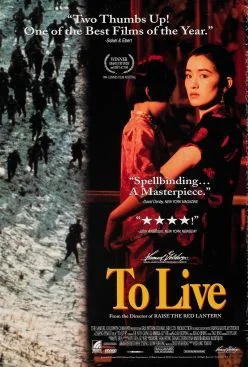
In Zhang Yimou's To Live (1994), one family's survival becomes a lens on political upheaval. Sidu Chen examines the film's tragic ironies, shadow puppets, and international reception, asking whether endurance is a form of resistance or a surrender to history.
Spoiler alert: Episodes and articles discuss plot details and key developments in the films covered. Please keep this in mind before listening or reading.
Sidu’s argument
The film’s emotional power leaves a political question unresolved: is survival resistance, or submission to history?
In the first episode of Objectionable, Sidu Chen considers Zhang Yimou’s
adaptation of Yu Hua’s novel through the lives of Fugui and his family.
The discussion moves from a plot synopsis to the relationship between
political promises, personal loss, and survival.
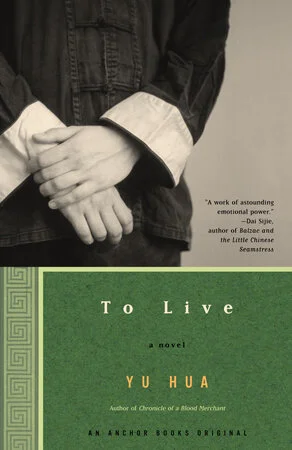
To LiveYu Hua’s novel, adapted by Zhang Yimou. Shown: the Anchor English-language paperback (2003); cover shown for identification. Publisher / edition.
In this episode
Political upheaval experienced through one family’s everyday life.
The tragic ironies surrounding Youqing and Fengxia.
Shadow puppets, the surviving wooden box, and the transmission of memory.
Roger Ebert’s response and the question of self-Orientalism in international reception.
Whether endurance amounts to quiet resistance or submission to history.
Survival and the limits of political cinema
Sidu questions what is lost when decades of political change are framed through
one family’s struggle. The film’s ending gives survival an emotional force,
but that force does not settle whether endurance resists power or submits to it.
The conclusion leaves that last question open, holding the film’s emotional
force alongside the limits of its political framing.
Welcome to Objectionable. This is a podcast about film and politics. With each episode, I will be taking you through how film can represent, portray, and interpret politics one movie at a time. Today, we'll start with To Live, adapted from Yu Hua's original book with the same title, directed by Zhang Yimou and starring Ge You and Gong Li. For those not familiar with the film, I will try to give a brief synopsis. This is not easy, considering the film crosses five decades of modern Chinese history, from the Second Sino-Japanese War to the Chinese Civil War, the Great Leap Forward, and the Cultural Revolution. Professor Dai Jinhua of Beijing University mentioned in her book Gathering Footprints that it is impossible to summarize a movie without subconsciously injecting some sort of perspective, some opinion into that summary. By choosing which events to skip over, which ones to emphasize, and which ones to treat with sensitivity, I am undoubtedly altering, even if to a small degree, the film's original ideas. I recommend that the movie be seen by yourself before you form some opinion of it based on my synopsis and analysis.
To Live follows the main character, Fugui. His name in Chinese means to be wealthy, and the first impression we get of him is as an irresponsible young man drinking and gambling his days away. His wife, Jiazhen, leaves him for a time with their daughter after his gambling addiction exacerbates, and he eventually gambles away his family's fortune and their ancestral home to a man named Long'er. Fugui's father dies of shock and anger, and Fugui is given a box of shadow puppets by Long'er, which he uses to start a traveling shadow puppet group and earn some money. Fugui and his partner and friend Chunsheng join the Kuomintang Nationalist Army during the Chinese Civil War and are later captured by the Communist People's Liberation Army. He returns home to his wife, daughter, and son and witnesses Long'er executed during communist land reforms.
With the family reunion, the film enters a new stage of political upheavals. China is now under communist rule. During the Great Leap Forward, the government mobilized the population to increase industrial and agricultural production. Fugui and other citizens are expected to contribute to collective labor, including melting down metal to make bullets and weapons. Fugui's son falls asleep against a wall one day at school and is killed by a car accident. The car belongs to Chunsheng, Fugui's former army companion who is now a local government official. The irony in this death is Chunsheng's lifelong dream was to drive a car, yet with the fulfillment of this dream comes this devastating tragedy.
Years later, during the Cultural Revolution, Fugui's daughter Fengxia marries a kind and hardworking man who works in the local revolutionary environment. When Fengxia goes into labor, the family takes her to a hospital. However, many experienced doctors have been denounced or removed from their positions during the Cultural Revolution, leaving only inexperienced students to provide treatment. The family manages to bring an experienced doctor to the hospital, but he is extremely weak from hunger after imprisonment and cannot properly exist. Fengxia suffers severe complications after giving birth and dies from blood loss. Following Fengxia's death, Fugui and Jiazhen continue raising their grandson. The film ends quietly depicting ordinary family life after the many tragedies.
Overall, the movie combines irony with realism to depict one family’s struggles within modern Chinese history. Certain elements, like the shadow puppets, symbolize how ordinary Chinese citizens were entirely controlled by political ideologies within that time. Depictions of events like the imprisonment of educators and doctors further portray the negative impacts of the Cultural Revolution.
The movie premiered in 1994 at the Cannes Film Festival and was denied release in movie theaters in mainland China for mainly two reasons: its portrayal of communist policies and its submission to the Cannes Film Festival without official approval. The two main actors were barred from co-productions for two years and from publicly discussing the film. The movie itself received major international recognition.
Structurally, the narrative framing of the movie relies on a relentless cyclical rhythm of political promise followed by devastating personal irony. Every time a new political era promises collective prosperity or societal advancement, it directly demands a sacrifice from Fugui’s family. The irony in To Live is tragic and systemic. For example, the death of their son, Youqing. The town is under the Great Leap Forward, a campaign aimed at rapidly industrializing China to surpass the West. Fugui, who is eager to prove his political enthusiasm for the communist government, persuades his exhausted son to go to school to participate in labor. It is this exhaustion that causes Youqing to fall asleep behind that wall. And Chunsheng, Fugui’s closest friend, who has finally achieved his modern revolutionary dream of driving an automobile, drives the car that crushes his son. In this case, the engine of China’s modernization literally crushes its own children.
We see this exact same structural irony play out during the Cultural Revolution with Fengxia’s death. The family goes to a hospital that has been swept clean of bourgeois expertise. The experienced doctors are locked away, and the hospital is run by teenage Red Guards. When Fengxia begins to suffer from a medical issue, the young students panic. Their ideological purity is completely useless against any form of medical emergency. The family manages to speak to Doctor Wang, an expert, but he has been starved in a confinement cell. In another stroke of irony, Fugui had just bought Doctor Wang seven buns to help him regain his strength. The starving doctor overeats, chokes, and falls unconscious, leaving no one to save Fengxia from bleeding to death. The state’s persecution of intellectuals paralyzes healthcare, education, and so many other sectors.
One element of the movie I found to be especially profound was the symbolism of the shadow puppets. In the novel, Fugui is a farmer tied to an ox. In the film, he is an artist tied to a wooden box. The puppets represent the fragile illusions of autonomy. At first, they are a wealthy man’s entertainment. In the Civil War, they are a literal shield. Fugui performs for the troops and soldiers, using art to camouflage his political neutrality and to survive. Under communist rule, the puppets are supposed to sing praises to Chairman Mao, showing how art must be reframed under communist propaganda. But during the Cultural Revolution, the town official warns Fugui that shadow puppets are remnant of old feudal culture and must be burned. Fugui and Jiazhen burn the puppets in their backyard, essentially watching their old lives go up in smoke to appease the changing political narratives.
The wooden box itself survives. At the end of the film, that box is used to hold a flock of small yellow chicks belonging to the grandson. The art is dead, the ideology has moved on, but the container of memory endures as a literal cradle for the next generation.
I'd like to start my analysis of the politics in the movie with a movie review from American Roger Ebert, a movie critic who gave the movie four and a half stars. I'll read a part of the review here. The best art, it is said, comes from turmoil, from hard times. In China, no serious filmmaking took place for decades, and now great films are coming in a torrent from that country. The authorities are not always so happy to have the nation's past examined with such frankness, and with films like To Live, there is a certain inexorable pattern. They are made, shown at foreign film festivals, honored, played briefly in a few sophisticated cinemas in Beijing or Shanghai, and then they disappear. It is exciting to see these new films as they emerge from China, their history being written, celebrated, and mourned.
This review is interesting because it frames China's political turmoil as a source of artistic significance. This is a complicated idea. Whose suffering becomes artistic material, and how does that suffering acquire value in the international cultural market? Roger Ebert’s review praises the film’s ability to span decades of Chinese history while remaining focused on ordinary people’s lives. In my opinion, however, there is one important tradeoff that comes with this perspective.
I’d like to talk about an interesting concept here called self-Orientalism. It is a sociological and cultural concept where people or societies from the East, or the Orient, internalize, adopt, and reproduce Western stereotypes, fantasies, and prejudices about their own culture. Self-Orientalism may not be a wordy jump to after seeing To Live. It certainly wasn’t the first thought I had after seeing the movie. In every sense, To Live is realist and depicts everyday life in a blunt way. But to put it frankly, it still serves a global market by packaging a massive chunk of complex Chinese history into an accessible melodramatic family chronicle that Western audiences can easily digest and emotionalize.
It’s important to note here that the book written by Yu Hua is certainly much more violent and absurd than the movie, in which the book everyone dies. The movie, by ending on a relatively warm domestic note where the surviving family eats a meal together around a table, it sanctifies the act of survival itself. It argues that for the ordinary Chinese citizen, the ultimate form of resistance against ideology is simply to live.
My opinion on this argument is complicated, and there is not a single agree or disagree answer I can give to it. I can, however, be sure that the politics of this film is inevitably limited when the director chose to depict Chinese history solely within the frame of family and individual struggles. This is not a critique of any means, and it is certainly not to say that this is a bad narrative technique, but it raises a question: what is the purpose of this film? To the West, it may seem like an emotional documentary of sorts, recording a life the West may otherwise never experience. To the Chinese, to me, it seems a little narrow to frame fifty decades of political upheaval into simple domestic family scenes. You only get one side of the story, and in reality, it just isn't that simple.
To close out today's episode, I want to look at an alternative perspective. I recently read an insightful movie review focusing on culture and anthropology from an anonymous blog, and I'll quote a small part of it here. Despite the sadness and the death, this movie really does live up to its title. In order to live, it seems, we have to live and die in such a way that our essence never goes away. It somehow survives in those things, places, and people we have touched.
The author of this post argues that the movie's true power isn't in its political critique, but in its existential humanism, the idea that human essence survives through communal memory, collective memory, and the physical objects we pass down, like Fugui's shadow puppet box.
That is, in my opinion, the ultimate paradox of To Live. Politically, it simplifies history to satisfy a global cinematic aesthetic, but emotionally, it captures an undeniable truth about human endurance. Whether that endurance is a profound act of quiet resistance or a passive submission to history is a question Director Zhang leaves for us to decide.
Thank you for listening to Objectionable, and I'll see you next time.