
Objectionable podcast cover Objectionable

Films they tried to silence.
Independent film research

Episodes/File 002

Episode 002 · ChinaProhibition & enforcement

Farewell My Concubine (1993)

Directed by Chen Kaige

· Sidu Chen

Historical selectivity does not make a film culturally meaningless. Sidu Chen considers identity, collective memory and the politics of looking in Chen Kaige's Farewell My Concubine (1993).

Spoiler alert: Episodes and articles discuss plot details and key developments in the films covered. Please keep this in mind before listening or reading.

Sidu’s argument

A film’s historical selectivity does not erase its cultural value. We also need to ask whose history we see—and how we have learned to look.

Read the argument
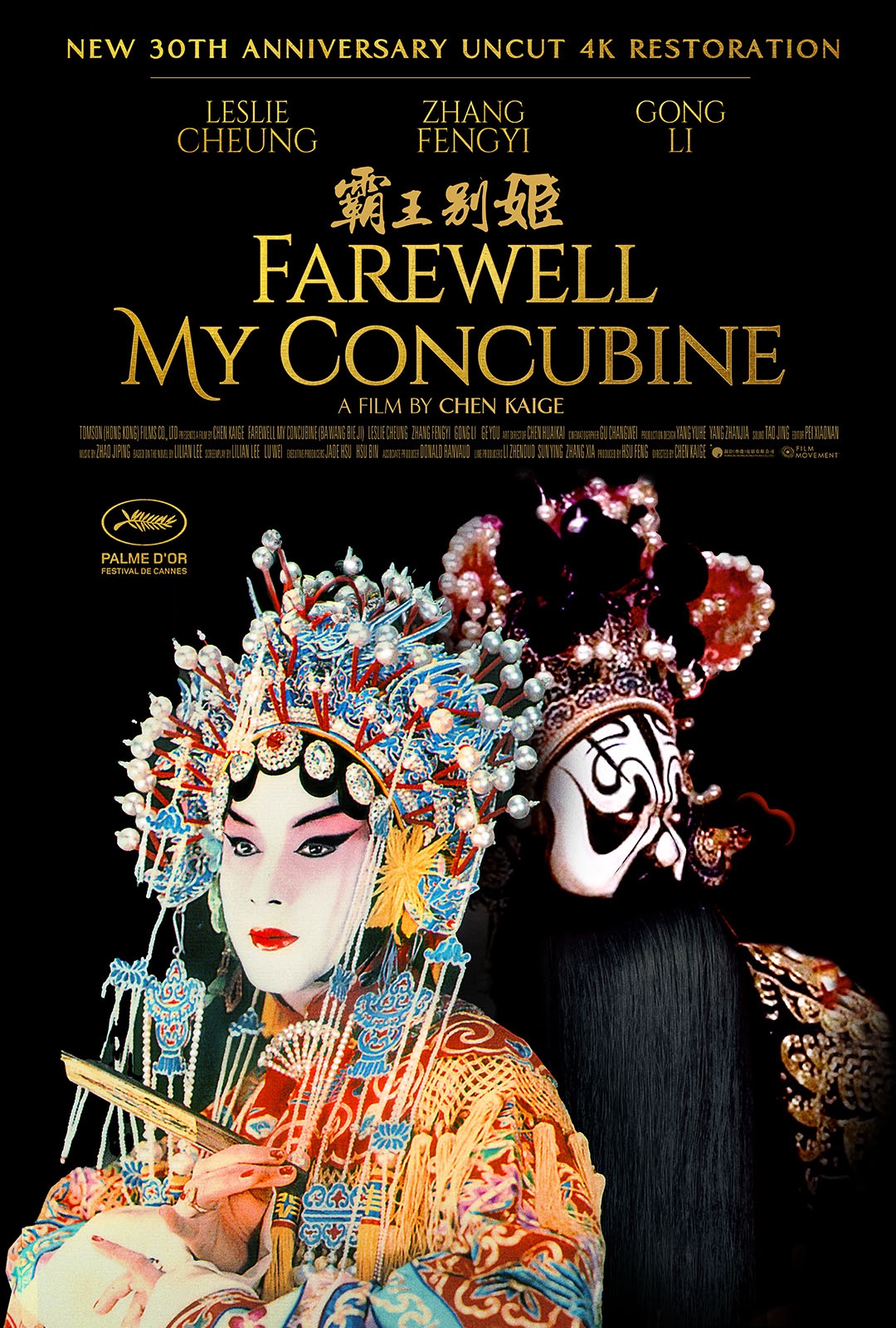
Farewell My Concubine — Film Movement Classics 30th-anniversary restoration poster
30th-anniversary 4K restoration poster — Film Movement Classics · Source
Listen to the episode16:38

Farewell My Concubine — Whose History Are We Seeing?

01 / Show notes

Sidu Chen examines Farewell My Concubine through a question that goes beyond whether a historical film is faithful to the past: what does its way of showing history allow us to understand, and what does it leave out?

Historical selectivity and cultural value

Sidu’s position: no film can contain every experience or perspective in a historical period. Selection is unavoidable, even in a long documentary. A film can simplify political circumstances while still communicating something meaningful about how people experience change. Being made with an international audience in mind does not, by itself, erase its artistic or emotional value.

This is also where Sidu qualifies the criticism he recounts from Dai Jinhua. He takes seriously the concern that Chinese history can become an exotic setting for a love story, but does not treat historical completeness as a sufficient test of the film’s value.

Understanding is not the same as inheriting memory

Sidu’s position: audiences can understand histories they have not lived. Understanding a story, however, is different from living with its consequences or inheriting its memory. Our responses are shaped by the histories and experiences we bring to the film.

That distinction is not a claim that Western audiences cannot understand Chinese history. The argument concerns unequal influence within global film culture: some perspectives, critical terms and aesthetic expectations have more power than others to define what a film means.

The discussion of Dieyi’s training makes this question concrete. Sidu reads his stage identity through discipline, punishment and institutions, rather than treating it simply as the natural expression of a personality. He also questions how critical praise for beauty and spectacle can sit alongside the violence the film depicts.

Whose history, through whose eyes?

Sidu’s conclusion: accuracy and beauty are not the only questions to ask. Whose history are we seeing? Through whose perspective? What might our own habits of looking keep us from noticing?

A film participates in politics through its selection of events, treatment of characters, visual language and reception—even without an explicit political argument. Sidu’s emphasis is on a more conscious relationship between aesthetic appreciation and historical understanding, rather than rejecting appreciation across cultures.

Sources in the conversation

The Swarthmore College essay provides the episode’s discussion of censorship as a negotiation among competing political, diplomatic and commercial interests. The recording also draws on Edward Said’s Orientalism, Achille Mbembe’s account of sovereignty and mortality, and Dai Jinhua’s criticism. These are attributed reference points; the positions set out above summarize Sidu’s response to them.

The reviews discussed later are by Brian Tallerico (2023) and Roger Ebert (1993). Their assessments of visual beauty, epic form and emotional accessibility are the starting point for Sidu’s own questions about international reception.

Film and release context

Chen Kaige’s 1993 film stars Leslie Cheung, Zhang Fengyi and Gong Li as Cheng Dieyi, Duan Xiaolou and Juxian. Its mainland restriction history includes an initial ban and a subsequent release with cuts. The film details use Cut as a short label for the modified mainland release, not a permanent worldwide prohibition or a claim about present availability.

Version clarification: the linked Swarthmore account distinguishes the mainland modifications from Miramax’s fourteen-minute North American cut. The recording’s early release-history passage compresses these different contexts; they should not be read as the same censorship decision.

The website poster identifies Film Movement Classics’ 30th-anniversary restoration; it does not establish which edition was watched for the recording. Official film and restoration information.

Soundtrack sources

The opening and closing include short excerpts of 啟幕 (Instrumental) and 京劇:霸王別姬 from the film’s original soundtrack, alongside the existing brand music. Rock Records’ soundtrack release. The film soundtrack excerpts are separate from Scott Buckley’s CC BY 4.0 track; that licence does not apply to the film recordings.

Credits

Music: “Growing Up” by Scott Buckley · CC BY 4.0 · Edited into opening and closing excerpts, with fades and level adjustment.
Film soundtrack excerpts: 啟幕 (Zhao Jiping) and 京劇:霸王別姬 — Farewell My Concubine original soundtrack, Rock Records.

02 / Transcript

Full text

Welcome back to Objectionable. This is a podcast about film and politics. With each episode, I will be taking you through how film can represent, portray, and interpret politics one movie at a time.

Today, we'll be looking at Farewell My Concubine, directed by Chen Kaige and released in 1993, one of China's most influential films.

Farewell My Concubine follows two main characters, Cheng Dieyi and Duan Xiaolou, two Beijing opera performers who meet as children while training at an opera school in Beijing. Their training is brutal, as highlighted by physical punishment, humiliation, and an almost obsessive emphasis on discipline. Dieyi is a boy who is repeatedly forced to perform the female role of Yu Ji in the opera of Farewell My Concubine opposite Xiaolou, who plays the male warlord Xiang Yu.

Over the years, the two become celebrated opera performers. However, the relationship between their stage identities and their private lives becomes increasingly complicated. Dieyi develops an intense emotional attachment to Xiaolou, while Xiaolou marries Juxian, a former prostitute.

The film takes us through several major periods of 20th century Chinese history, including the Japanese occupation, the establishment of the People's Republic of China, the political campaigns of the Mao era, and ultimately the Cultural Revolution. As political circumstances change, so do the positions of the characters. Their identities, relationships, and even their artistic professions become subject to political scrutiny. What begins as a story about two performers and their relationship gradually becomes a tragedy about the intersection of private life, identity, and political power.

The movie was originally banned temporarily in mainland China, but following its huge international success, the authorities agreed to release the film after 14 minutes had been cut, including scenes dealing with the Cultural Revolution and homosexuality. The film remained barred from showing in theaters after its ban.

In my research, I found a really interesting essay by a student studying queer media from Swarthmore College about the censorship of Farewell My Concubine, and it's so well written that I'll read a large part of it here.

Although the Chinese government had been loosening restrictions across the media spectrum, Farewell My Concubine struck a nerve. Reportedly, the police personally viewed the film and decided to ban it indefinitely, demanding severe cuts.

This ban was not absolute, however. The government allowed the two weeks of showings in Shanghai, for which tickets had already been sold out. Then Deng Xiaoping watched the film and intervened, successfully pushing for its re-release with only three cuts.

But just because the CCP permitted Farewell My Concubine's mostly whole mainland China release didn't mean that its members had to be happy about it. Some grumbled about how China's bid for the 2000 Olympics forced them to relent in order to appear less authoritarian. Others took to Qiushi, a party journal, to criticize the film's homosexuality as perverted and designate homosexuality a pre-1949 artifact. Nevertheless, Farewell My Concubine was a hit in mainland China, both at the box office and on pirated videotapes.

Narratives regarding artistic freedom versus censorship are often reduced to either the glorious triumph of the great thinker or totalitarian oppressors crushing freedom, but the Farewell My Concubine's release in mainland fits neither mold. Rather, it is a Karl Marx-esque tribulation caused by the interplay between a myriad of contradicting forces ranging from the need to display power, reform efforts, international relations, and nation building.

The rest of this essay can be found in the further reading segment on the website. The way I interpret it, this essay suggests that the censorship of Farewell My Concubine was a political negotiation involving competing interests within the state, international diplomatic considerations, cultural ideology, and the commercial film industry. It is not simply independent filmmaker versus authoritarian government.

The main takeaway here is that the Chinese political system should not be understood as a single actor with one consistent position. Different political authorities and officials can have different priorities within the same government. For example, some officials may have considered the film politically damaging because of its representation of Chinese history and the Cultural Revolution. Others have considered its international success and cultural significance worth preserving. Deng Xiaoping's intervention suggests that the political leadership could override earlier decisions when broader political considerations have evolved.

The essay goes on to argue that film censorship in China is caught in an Orientalist catch-22. The perfect Chinese film for a Western audience would be 0% celluloid, 100% cuts.

For certain Western commentators, the ideal Chinese film is one that does not exist. What matters is not necessarily its cinematic content, but the evidence of censorship surrounding it. Why? Because censorship confirms an existing narrative about China, that it is authoritarian, politically repressive, and fundamentally opposed to Western liberal values. In this case, the film itself becomes secondary; its censorship becomes the actual story.

This is a direct reference to Orientalism, particularly Edward Said's argument that Western representations of the East often constructed as fundamentally different from and inferior to the West.

And here, I'd like to quote Achille Mbembe in his essay Necropolitics: The ultimate expression of sovereignty resides to a large degree in the power and the capacity to dictate who may live and who must die. Hence, to kill or to allow to live constitute the limits of sovereignty, its fundamental attributes. To exercise sovereignty is to exercise control over mortality and to define life as the deployment and manifestation of power.

He argues that sovereignty is ultimately demonstrated through the ability to exercise control over mortality. In simpler terms, the most fundamental expression of political power is the ability to determine the conditions under which other people live or die. This includes not only the direct power to kill, but also the power to expose certain populations to conditions in which death becomes more likely.

Connecting that idea to the most emotionally impactful moment of the show, where Dieyi commits suicide, it is seen by many as unwarranted because by that point, the Cultural Revolution had already ended and there is no one who can drag him out into the street and denounce him for his homosexuality. Perhaps the significance of this ending lies in the moment of supremacy over his mortality, where he confers the value of his own body into an expression of homosexuality.

And with that, transitioning from looking at the movie censorship and more into the politics it provokes thought into, I'd like to share a recent experience I had with Professor Dai Jinhua of Peking University. I had the privilege to ask her two questions regarding collective memory, and I used Farewell My Concubine as an example.

My questions are as follows. In my research on the relationship between film and politics, I came across the concept of collective memory. It made me realize that films are not objective representations of history because any attempt to recount the past inevitably involves a process of selection and omission. In fact, one could argue that every time we retell the past, we are not simply presenting history but reconstructing it.

Take Farewell My Concubine, for example. Through the personal lives and tragic fates of Cheng Dieyi and Duan Xiaolou, the film transforms the complex political transformations of modern Chinese history into a deeply dramatic and emotionally powerful personal tragedy. If we also consider its success and circulation in the international market and the associations it creates between Western audiences and Chinese history, my question is: how should we understand the history, the version of history, that this film constructs?

Professor Dai wrote in her book Landscape in the Mist that she did not enjoy Farewell My Concubine because it took five decades of complex Chinese political history and made it the exotic Oriental backdrop of a Hollywood love story. It is not a wholly accurate representation of Chinese history, and it is not even an accurate representation of Chinese opera.

Though I agree with this stance, I think it is not an absolutely valid criticism of Farewell My Concubine because there is no movie that can accurately represent all the nuance and perspective in modern Chinese history. Even a six-hour documentary would have to make decisions about what to include, what to exclude, and whose experiences deserve more attention.

More importantly, we must distinguish between accurate historical representation versus cultural value. A film can be historically selective without being culturally meaningless. It can simplify certain political circumstances while still communicating something meaningful about how individuals experience political change. The fact that Farewell My Concubine might have been made with an international audience in mind does not automatically diminish its artistic or emotional value.

In fact, I think this tension becomes even more interesting when we examine how Western critics have received the film, and let’s look at a couple of reviews.

Directly quoting someone in a blog, he says that of course there are unforgettable scenes before the ending of Chen’s epic too. In fact, throughout the piece, enabled by Gu Changwei’s fluid lyrical camera work that almost always perfectly frames his characters without calling attention to the piece’s epic nature, Farewell My Concubine is somehow both breathtakingly gorgeous but also tactile and relatable at the same time. It doesn’t fall victim to the traditional trappings of films that unfold over a half century, movies that often place too much weight on the production and costume design, making them feel distant. Farewell My Concubine takes place in a world unlike most of those occupied by its viewers, but the emotions and empathetic storytelling make it current and resonant.

And another review says that the movie is a demonstration of how a great epic can function, and that the author was generally familiar with the important moments of Chinese history, but this film helped the author to feel and imagine what it was like to live in the country during those times.

And I would like to share some thoughts I have had after reading these reviews. Firstly, I don’t agree with the classification of Dieyi as a feminine child, which apparently is a perceived reason for why he grew up to become Yuji in the actual opera. It is as though his eventual performance as Yuji is simply the result of an inherently feminine personality. I think that this interpretation overlooks the circumstances in which his identity is formed. His training is not simply an artistic education; it is a process of discipline and force, and it is not in any way natural. He is repeatedly punished until he learns to embody the female role required of him. His transformation into Juxian therefore raises questions about the relationship between identity and performance. To what extent is identity something we are born with, and to what extent is it something imposed upon us by institutions, expectations, and the people who hold power over us?

Secondly, words like gorgeous and epic and empathetic make me skeptical of the reviews in general. No part of the movie is gorgeous to me. Most of it is in fact horrifying, and I'm guessing the reason that these words were chosen reflects the way that Chinese history is transformed into a backdrop consisting of fire and mist and exotic colors.

Finally, I'm guessing that this is the exact type of review I would write if I saw a Western movie as provoking as this into the political history of the English-speaking world. I can't think of an example for Western movies appeal to Western cinema in Hollywood and not a Chinese audience, while that situation is reversed for a lot of movies from China. I'm not sure there's been any movie really that, for example, took the Pearl Harbor bombing and turned it into a beautiful aesthetic Western backdrop for a love story between two soldiers or something.

The point is, neither history nor collective memory can be defined as real or not real. Everything that people experience is real, and sometimes people can have different perceptions of the same thing. The power to represent history is also the power to shape how other people understand it, and that power is not always distributed equally. When a Chinese film travels to an international audience, it does not arrive in a neutral space. It enters a global film culture in which certain perspectives, certain narratives, critical vocabularies, and aesthetic expectations already have a greater influence.

This does not mean that Western audiences are incapable of understanding Chinese history, or that Chinese history is only unique to Chinese audiences. That analysis would simply replace one cultural hierarchy with another. Rather, it suggests that our interpretations are shaped by the historical memories and experiences that we bring with us. We can understand events that we have not personally experienced, but understanding them is not the same thing as having lived with their consequences or inherited their memory.

And in my opinion, that is exactly why film is politically significant. A film does not need to make an explicit political argument to participate in politics. Through its selection of events, its treatment of characters, its visual language, and even the way it is received internationally, it can influence what audiences remember and how they understand the past.

So I don't think the answer is that international audiences should avoid appreciating the beauty of Farewell My Concubine, or that the film loses all of its value because it presents Chinese history through a particular cinematic style. Rather, we as different audiences should be more conscious of the relationship between aesthetic appreciation and historical understanding.

So perhaps the question we should ask when watching a film about another society's history is not simply whether its representation is accurate or beautiful. It is also whose history are we seeing, through whose perspectives are we seeing it, and what might we be missing because of the way we have learned to look at it.

Thank you for listening to Objectionable, and I'll see you next time.

03 / Further reading

04 / Related analysis